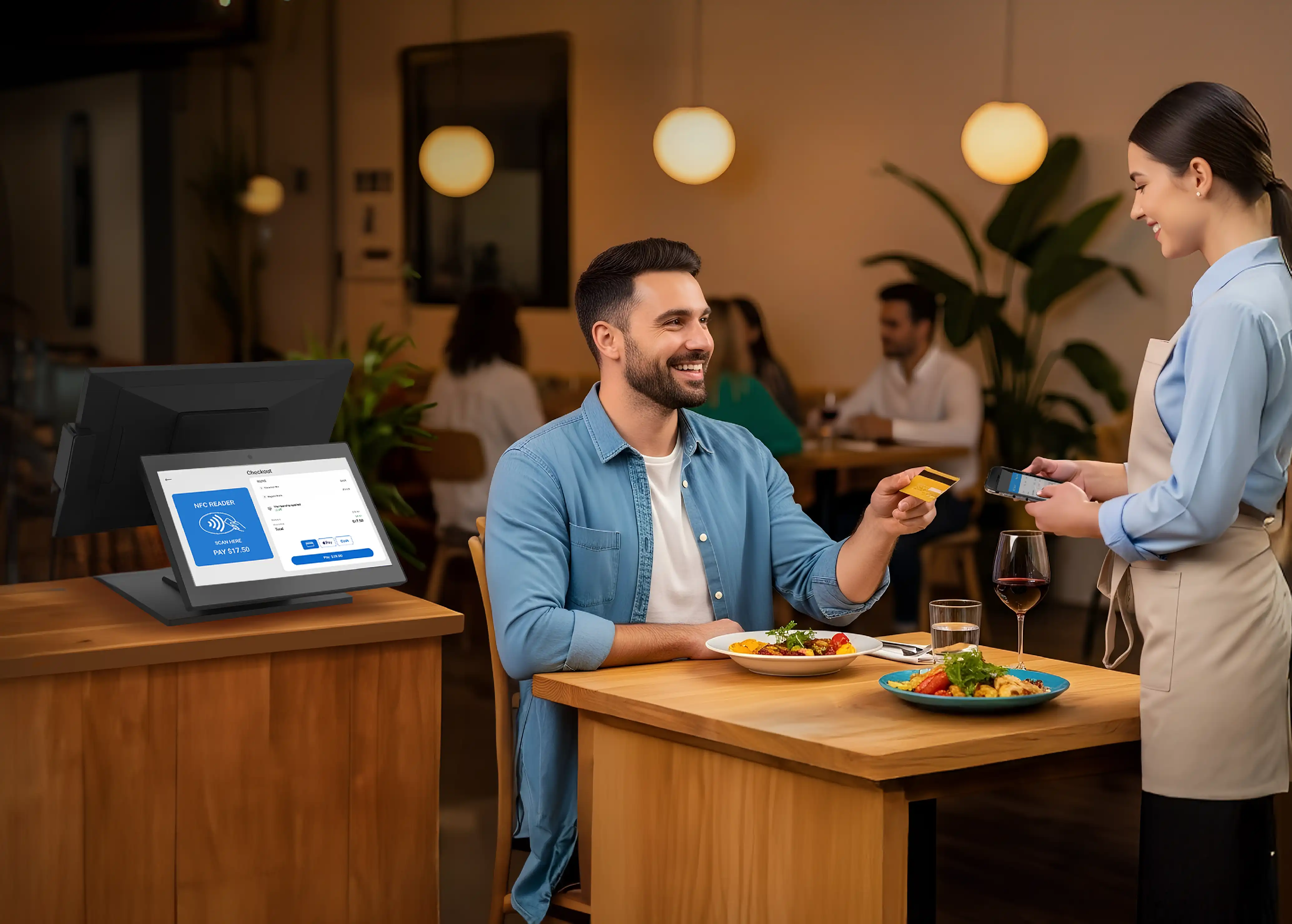
From full-service dining to fast-casual concepts and pop-up eateries, restaurants come in more formats than ever. Yet for decades, traditional fixed counters have been the backbone of restaurant operations. As store formats evolve and customer expectations shift, this long-standing setup is no longer sufficient.
Today, a traditional dine-in restaurant may find its staff tied to fixed terminals when they should be moving between tables to maximize turnover. Food trucks often struggle with bulky hardware that limits mobility, and pop-up venues are challenged to keep up with ever-evolving payment preferences with makeshift setups.
In response, many businesses are turning to handheld POS solutions, which deliver unmatched mobility and payment flexibility in a streamlined, all-in-one device. However, with so many options available, how can businesses choose a handheld POS that truly fits their operational needs without overpaying for unnecessary features or underinvesting in critical ones?
Understanding Payment Options for Handheld POS: SoftPOS and Full-Function Payment Modules
For restaurant operators evaluating handheld POS options, the hardware specs, such as screen size, battery life, and processing power, are usually easy to compare. The harder question is what's happening on the payment side, and that comes down to regulation. Because a handheld POS doubles as a payment terminal, the device must comply with the strict payment regulations of the market it operates in. For example, some countries have widely accepted software-based payment, while others require certified, full-function modules. Getting this choice wrong doesn't just mean a feature gap. It can mean deploying a device that's non-compliant in its operating market.
Broadly speaking, restaurants today can choose between two payment approaches on a handheld device: SoftPOS, a software-based solution requiring no additional hardware, and a full-function payment module, a certified hardware component that supports chip, swipe, and contactless transactions. For restaurant operators, the right choice depends on regulatory environment, business format, and transaction volume.
Here is a closer look at both payment functionalities:
SoftPOS Technology
SoftPOS turns the device into a contactless payment terminal using the built-in NFC capability. With no additional hardware required, it offers cost-effective implementation with minimal infrastructure investment and simplified deployment. While SoftPOS is best suited to markets with more developed regulatory frameworks and established contactless payment ecosystems, the technology is rapidly gaining traction among small businesses looking for agility and reduced hardware dependence.
Full-Function Payment Technology
In some countries where regulations require certified, dedicated hardware for chip, swipe, and contactless transactions, SoftPOS is no longer compliant. A full-function payment module allows merchants to accept all major payment types through established, well-understood compliance pathways. This approach becomes the better option for operators serving high transaction volumes or operating in markets where SoftPOS regulatory frameworks are still developing.
Key Certifications for Handheld POS Security and Enterprise Deployment
Regardless of which payment methods a market supports, certifications are what make a handheld POS trustworthy and deployable at scale. The key advantage of a handheld POS lies in its ability to consolidate both a POS terminal and a payment device into a single mobile platform. While consolidating POS and payment functions into a single device is convenient, this convergence introduces a critical risk. When payment-capable devices are deployed across multiple locations and used outside controlled environments, transaction data faces greater exposure to potential security threats.
PCI PTS: Hardware Security for Payment Terminals
PCI PTS (PIN Transaction Security) is a security standard governed by the PCI Security Standards Council, specifically designed to address the security requirements of PIN-accepting payment terminal hardware. It establishes stringent requirements to protect against fraud, including attempts to extract encryption keys, tamper with sensitive components, or install data-skimming mechanisms. To achieve PCI PTS certification, a device must be evaluated by a PCI SSC-accredited laboratory to verify compliance with its physical and logical security requirements. In practical terms, PCI PTS certification provides assurance that the payment hardware meets the security expectations of card networks, acquiring banks, payment processors, and customers alike.
Google EDLA and AER: Enterprise Standards for Secure Device Management
In addition to payment hardware security, device-level certifications play an equally important role in ensuring reliable and manageable enterprise deployments. As Android has become a widely adopted platform for restaurant POS and handheld solutions, certifications built around this operating system have become increasingly relevant for large-scale restaurant operations.
Google Enterprise Device Licensing Agreement (EDLA) is a foundational certification that validates the suitability of a device for enterprise deployment. As part of the broader Google Mobile Services (GMS) certification framework, EDLA ensures that enterprise handheld devices are authorized to access Google Mobile Services and receive regular system updates that align with enterprise-grade security standards.
Beyond system updates, device manageability is another key consideration. Android Enterprise Recommended (AER) is a Google program that certifies devices for enterprise fleet management. AER-certified devices support zero-touch enrollment and are compatible with major enterprise mobility management platforms. This enables IT teams to remotely manage configurations, push security patches, and maintain consistency across an entire device fleet spanning multiple restaurant locations.
A trusted and scalable handheld POS should not only safeguard payment data, but also deliver the reliability, compliance, and centralized management capabilities needed for secure, enterprise-scale deployments. Certifications such as PCI PTS, Google EDLA, and AER serve as key indicators of whether a handheld POS is equipped to support such deployments across different markets.
Introducing M252: Modular Handheld POS for Every Market
As we've discussed throughout this article, selecting a handheld POS involves far more complexity than choosing a traditional countertop POS or kiosk. Restaurant operators must evaluate everything from operational workflows and payment requirements to security standards and regulatory compliance. This naturally raises a question: Can a handheld POS platform adapt to the diverse needs of different restaurant formats and regional markets?
With this challenge in mind, Flytech developed the M252, a modular handheld POS designed to meet the needs of restaurant operators across different business models, payment environments, and regulatory requirements. At the heart of the M252 is its modular payment design. Using the same device platform, operators can choose between a SoftPOS configuration or a full-function PCI PTS-certified payment module, allowing the device to meet the specific needs of each market. This flexibility helps businesses standardize hardware across regions while maintaining compliance with local payment regulations.
Alongside payment flexibility, the M252 is built for long-term enterprise deployment. Powered by Android 15 and certified under both Google EDLA and AER, it delivers enterprise-grade security updates, Google Mobile Services access, and robust fleet management capabilities, whether deployed in a single location or across multiple restaurant sites.
From full-service dining to food trucks and pop-up concepts, the M252 adapts to evolving operational needs without requiring businesses to compromise on compliance, security, or operational flexibility.
Interested in learning more about how the M252 can support your business? Visit our product page or contact our team to find the right solution for your operation.